

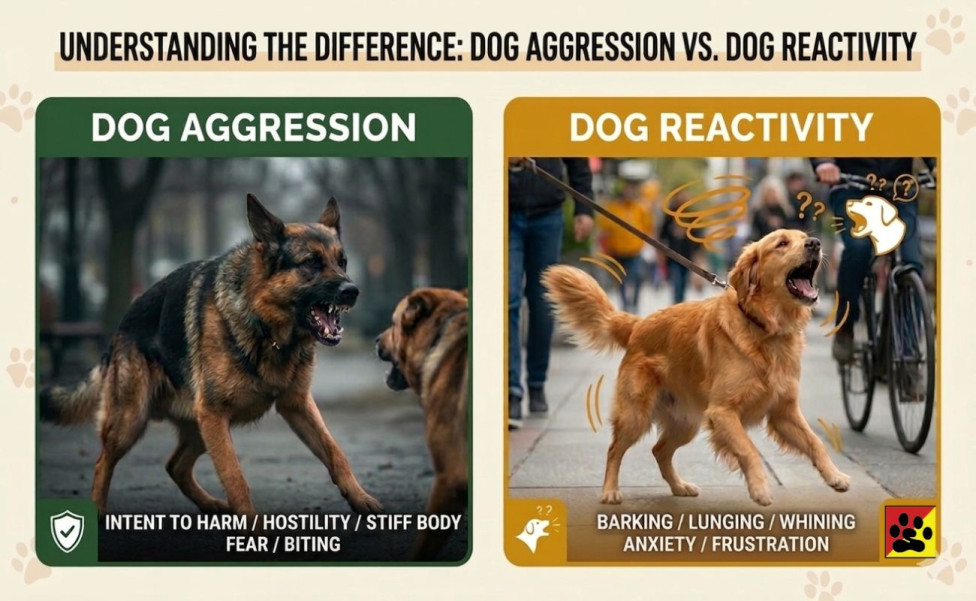
As a dog behavioral therapist and owner of Bark Busters Home Dog Training in Southwest Orlando, I’ve helped over a thousand dog owners train their dogs and improve their relationship. One of the most common labels I hear dog owners use to explain their dogs behavior is “aggressive”.
This label gets thrown around quite often for common behaviors like barking, lunging, jumping etc. It's important to consider the dog's temperament, body language, environment and relationship with their owner before blanket defining these behaviors as “aggressive”. It’s likely that these behaviors are simply the result of a dog experiencing reactivity.
The difference may not seem significant, but it changes how dog owners behave and what training they implement. When a dog is labeled aggressive, many dog owners feel they need to become more physical, resorting to aversive tools like electric collars, prong collars, etc. These tools do not enhance your relationship with your dog. They often exacerbate the issues, causing tension and keeping the dogs in a fight-or-flight mental state - utilizing fear vs leadership.
In fact, it’s possible to turn a reactive dog into an aggressive dog with these tools. In the dog World, the leader isn’t the loudest and most physical. We’ll get to more of that later.
What Exactly is the Difference Between Aggression and Reactivity?
You’ll likely find differing opinions about this, but I will share what I’ve seen in my 17 years as a dog trainer. Let’s start first with aggression.
What is Dog Aggression?
The primary driver of aggression in dogs is fear. Fear in dogs is driven by several factors:
- Improper conditioning
- Limited controlled exposure and training to different environments
- Other dogs, people and items
- Experiencing significant trauma
Aggressive dogs have not developed trust and are often intent on harming perceived threats and triggers. They’re much more static in their body language and more fixated and quiet. This usually looks like staring out of the corner of their eyes alongside a deep guttural tone. Following that is a quick snap either to threaten or to bite. They often stay in this state even after the trigger has gone away.
What is Reactivity?
Reactivity in dogs can also be driven by fear but it’s normally driven by nervousness or over excitement and stimulation. Reactive dogs tend to use a higher-pitched bark accompanied by lots of panting, pacing, jumping or lunging. These dogs have not learned how to regulate their emotions and lack socialization training or experience in different environments.
They are unsure what they’re supposed to do when around something that entices them. With certain reactive dogs, this can lead to a snap or bite incident in the wrong environment, particularly on a leash.
Why Lack of Mental Stimulation Keeps Dogs Stuck in Reactive and Aggressive Behavior
Both aggressive and reactive dogs lack mental stimulation. Most learn by association that they don’t need to use their brain to get what they want. Dogs learn by association; therefore, without proper leadership and training, they will teach themselves to stay in an adrenalized state to solve their problems or deal with threats. It’s like having an argument with someone and saying or doing something you later regret. You weren’t thinking clearly and your actions were completely out of character. The difference with humans is we know how to regulate our emotions. Dogs do not.
Imagine a dog that sits by the window all day long. When they see a person, a dog or any other trigger walk by their “den”, they bark, jump, etc. until that trigger is gone. What has the dog learned in this scenario? They’ve learned that to get something they fear away from them and their pack, they need to act in an adrenalized manner. There is zero thinking happening when a dog acts like this.
Teach Your Dog to Think, Not React: A Better Path Than Fight or Flight
Both aggressive and reactive dogs need to be taught that instead of fight or flight, there’s another path. That path is the Bark Busters method which I teach dog owners every day to naturally communicate using body language, tone of voice, claiming space and using influence to their advantage.
When you can get your dog to react to you as opposed to you reacting to them, you will see a huge improvement in their behavior. This is done by consistent training, 15-20 minutes each day, making daily, weekly and monthly progress. It’s done in your home by setting the scene and controlling your environment and distractions.
Relationship building is extremely important when it comes to training your dog. That’s why our methodology turns you into your dog's best trainer and communicator. The proper exercises and tools will accomplish this, build on your bond, trust and respect and get your dog to think. A thinking dog is a calm dog. A calm dog is a happy dog.